
DISC Profiling Workshops for New Zealand Teams
DISC is an organisational development tool. The core concept of DISC assessment is to profile people's natural behaviour. Scientifically validated, DISC personality testing provides a profile that identifies a person's DISC type which helps individuals and teams improve communication and collaborate more effectively.
Archetype Leadership + Teams delivers DISC workshops and facilitation for New Zealand teams. Individual DISC profiles are purchased directly at New Zealand's dedicated Everything DiSC profiling hub, powered by Wiley.

What is DISC?
DISC is a personality test that focuses on behavioural tendencies. It's used in many organisations around the world to help millions of people become more effective in their work and to help teams become better at working together.
How Does DISC Help Personal Development?
DISC is a behavioural assessment tool used by organisations worldwide to help individuals and teams work more effectively together. Based on research by psychologist William Moulton Marston, DISC measures natural behavioural tendencies across four dimensions: Dominance, Influence, Steadiness, and Conscientiousness.
Unlike broader personality tests, DISC focuses specifically on observable workplace behaviour — how people communicate, make decisions, and collaborate. Because behaviour is both observable and modifiable, DISC produces immediately practical insights. Everything DiSC, developed by Wiley, is the world's leading DISC platform, with over 45 million profiles completed across 72 countries.

Their report increases their self-awareness and includes suggestions that make it easy for them to understand how they can be more effective at work by understanding their natural or preferred working style and then considering the ways their assessment results suggest they could be even more effective.
How Does DISC Help Teams?
When members of a team take DISC assessments they each get a DISC profile.
DISC helps a team to work better together by providing concise insights about how each team-member works and highlighting the similarities and differences between team-mates.
The outcome is better collaboration, communication and productivity. When members of high-performing teams understand how each other likes to work they are more effective at collaborating with and influencing others in the team. To do this, DISC helps them to take an adaptive approach to working together - to use DISC to help them know how to best connect with each other. When a team embrace this approach it becomes a lasting behaviour, lifting their performance.
Beyond Team Building
Team building looks to build relationships in a team. When DISC is used, teams go beyond relationship building to real development. Team dynamics become more visible and able to be improved. DISC is particularly powerful when an organisation is looking to assemble teams.
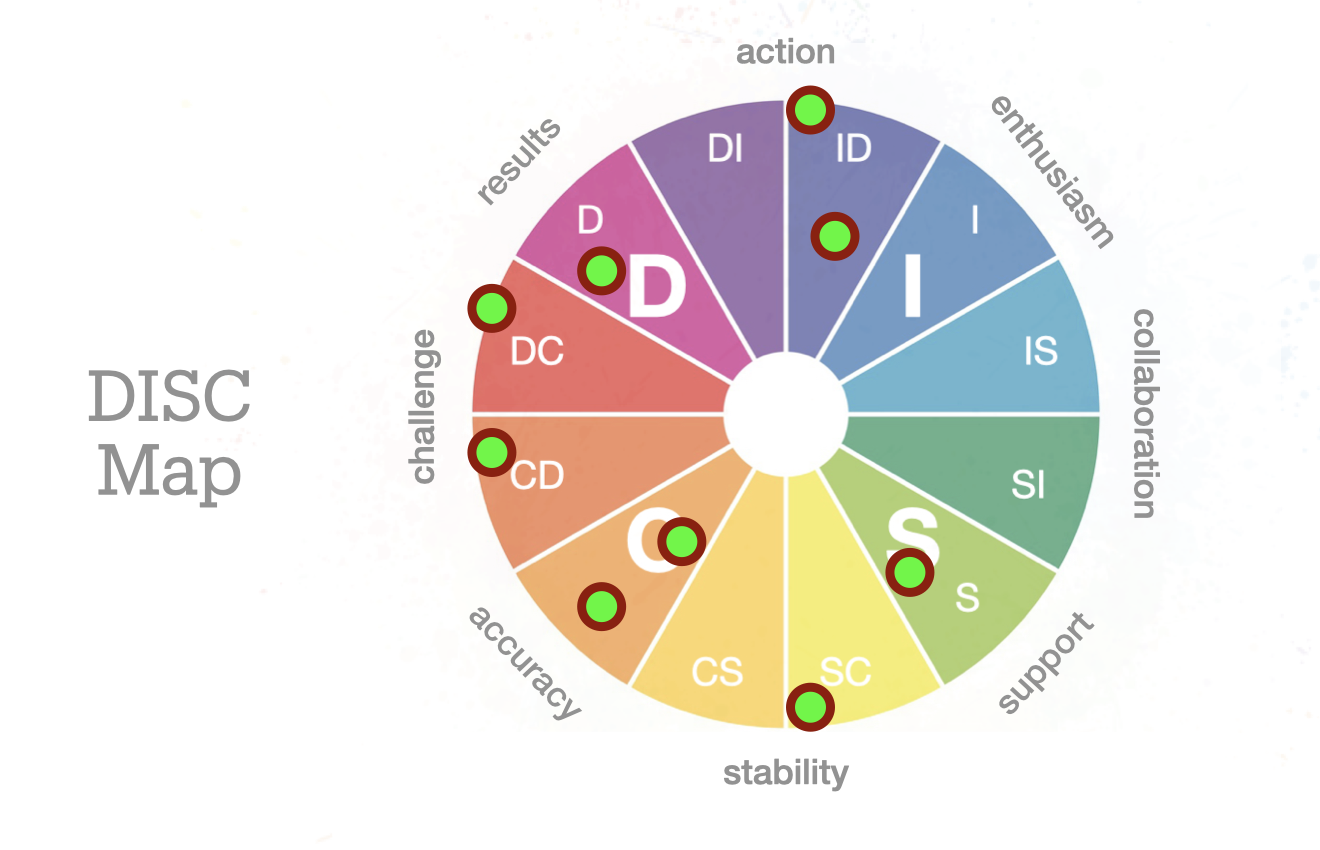
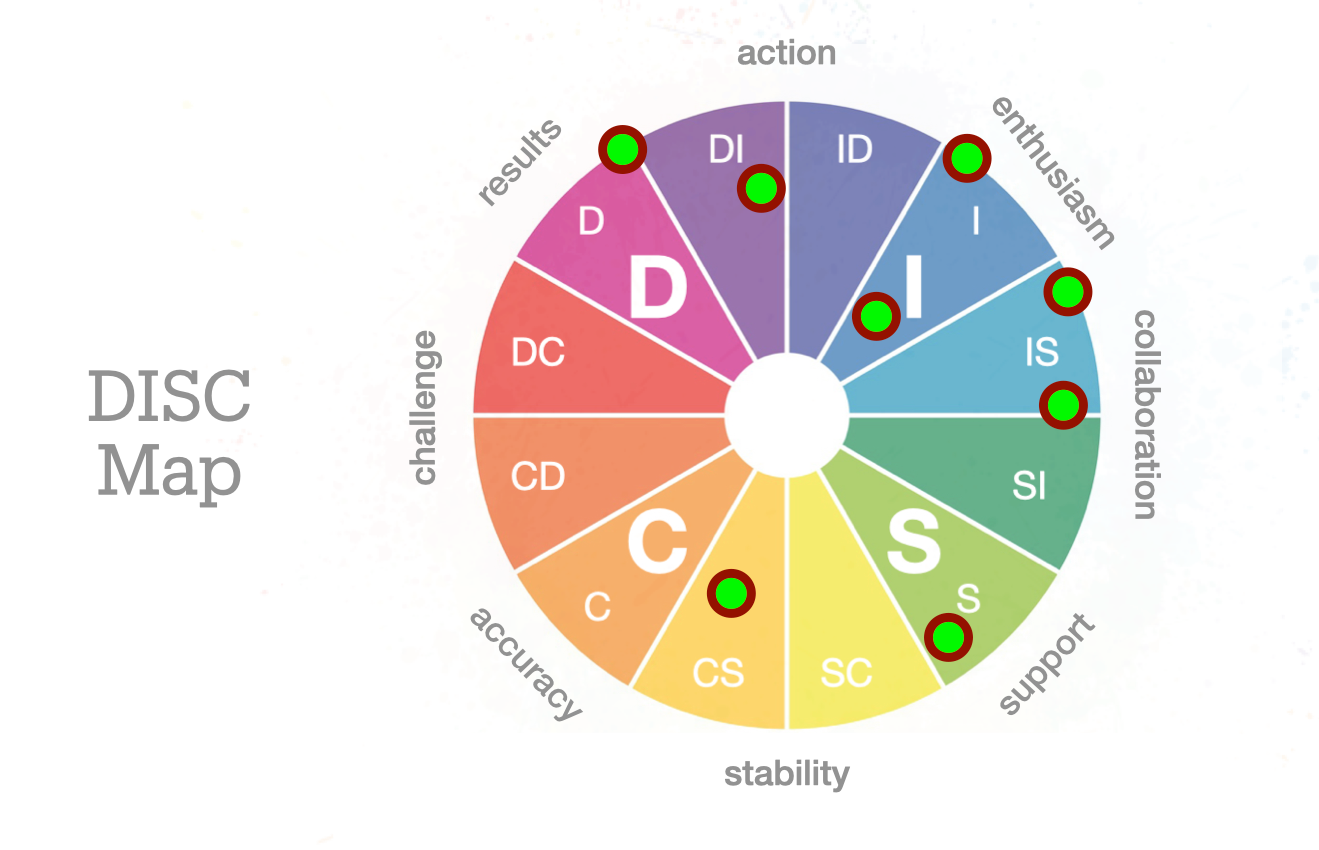
DISC Map
A team DISC Map uses the DISC framework of 12 styles to clearly show each team-members type immediately supporting communication and collaboration.
How Does DISC Work?
The Four DISC Dimensions
Based on research by psychologist William Moulton Marston, the DISC model is a behavioural assessment tool that uses DISC factors to categorise individuals personality traits into four primary personality types: Dominance, Influence, Steadiness, and Conscientiousness.
When a person completes a DISC test their behavioural style is identified in a DISC report. Each style represents distinct behavioural traits and communication styles - their preferences and tendencies at work.
Dominance individuals are assertive and results-oriented, while Influencers are social and persuasive. Steadiness types value harmony and consistency, and Conscientiousness individuals are analytical and detail-oriented.
The model helps individuals understand their own behaviours and those of others, fostering better communication and teamwork. By identifying these traits, organisations can enhance employee interactions, improve productivity, and create a more cohesive work environment, ultimately leading to better overall performance.
A Common Language
Another way the DISC personality model works is the common language it provides. In a team, or across an organisation, when people use the same words to identify and describe things the ideas and actions those words represent are adopted more quickly and effectively.
The DISC Framework in Organisational Development
DISC is more than a personality test - it is a practical framework for understanding how people naturally behave at work, what motivates them, and what creates pressure for them. It is a practical organisational development tool that lifts teamwork and leadership.
The four DISC dimensions (Dominance, Influence, Steadiness, and Conscientiousness) are not fixed types. They describe adaptive behavioural preferences that shift with context. Understanding this is what separates sophisticated DISC application from surface-level personality labelling.
Team Development
When every member of a team has a DISC profile, the team gains a shared language for how they work. Communication improves because people understand not just their own preferences but how their colleagues prefer to give and receive information. Collaboration deepens because the differences that once caused friction - pace, detail, directness, consensus-seeking — become visible and nameable rather than a source of misread intent. DISC doesn't change how people are wired. It changes how well a team understands and works with those differences.
Leadership Development
Effective leaders know that how they lead needs to flex to the people they lead. DISC gives leaders the self-awareness to understand their leadership style - how they make decisions, communicate, respond under pressure, and motivate others - as well as the insights to recognise those same patterns in the people they lead.
That combination is what makes DISC particularly powerful in leadership development: it is simultaneously a tool for self-reflection by a leader and a practical framework for leading others more deliberately.
A Practical Tool
Where many tools describe behaviour, DISC explains it - and gives leaders an immediately actionable framework for working with their people more effectively - growing themselves as leaders and their people and team at the same time.
At Archetype Leadership + Teams, we use DISC as a starting point for the kind of adaptive leadership that genuinely lifts leader and team performance.
The Everything DISC Platform
Archetype uses the world-leading Everything DiSC platform. Over 45 million people around the world have taken this assessment. Archetype Leadership + Teams has delivered Everything DiSC workshops for teams from Whangarei to Invercargill across local government, financial services, healthcare, and professional services.
We use Everything DiSC® — Wiley's research-validated platform — because its adaptive assessment engine and Catalyst digital platform go beyond a static report to support ongoing team learning.
Profiles can be purchased directly at New Zealand's dedicated Everything DiSC profiling hub.

DISC Workshops
A DISC workshop is an engaging 2-3 hour group workshop that ensures participants understand DISC theory and the practical framework. They quickly understand DISC, their own working style and their colleague’s working styles.
Online and In-Person Delivery
DISC workshops can be online or in-person. The result is a practical understanding of how to communicate and collaborate more effectively with other people and how to reach higher performance as a team.
Individual DISC Assessment
An individual DISC personality assessment guides a person to better understand how they can be more personally effective and how they could work more effectively with others. It includes helpful suggestions about what they may do a little differently to be more effective at work.
DISC Team Reports
A DISC team report draws on the individual reports for each team-member to provide customised insights and recommendations on how that team tends to work and how it could become even more effective.
Frequently Asked Questions
What is a DISC assessment?
A DISC assessment is a behavioural profiling tool that measures how people tend to act, communicate, and respond at work. It categorises behavioural style across four dimensions — Dominance, Influence, Steadiness, and Conscientiousness — and produces a personalised report with practical insights.
How long does a DISC assessment take?
Most people complete a DISC assessment in 15–20 minutes. The online questionnaire is straightforward and there are no right or wrong answers.
What is a DISC workshop?
A DISC workshop is a facilitated 2–3 hour session where team members share and explore their DISC profiles together. The outcome is a practical understanding of how to communicate and collaborate more effectively as a team.
How does DISC help teams?
DISC gives every team member a shared language for understanding behavioural differences. Teams learn how their different styles interact, which reduces friction, improves communication, and lifts performance.
What is the difference between a DISC profile and a DISC team report?
A DISC profile is an individual assessment. A DISC team report draws on the individual profiles of all team members to provide insights and recommendations specific to how that team works together.
What does DISC stand for?
DISC stands for Dominance, Influence, Steadiness, and Conscientiousness. These are the four behavioural dimensions the DISC model uses to describe how people tend to act and communicate at work. Dominance relates to how a person responds to challenge and exerts control. Influence relates to how they interact with and persuade others. Steadiness relates to their pace and need for consistency. Conscientiousness relates to their attention to quality, accuracy, and rules.
How many DISC styles are there?
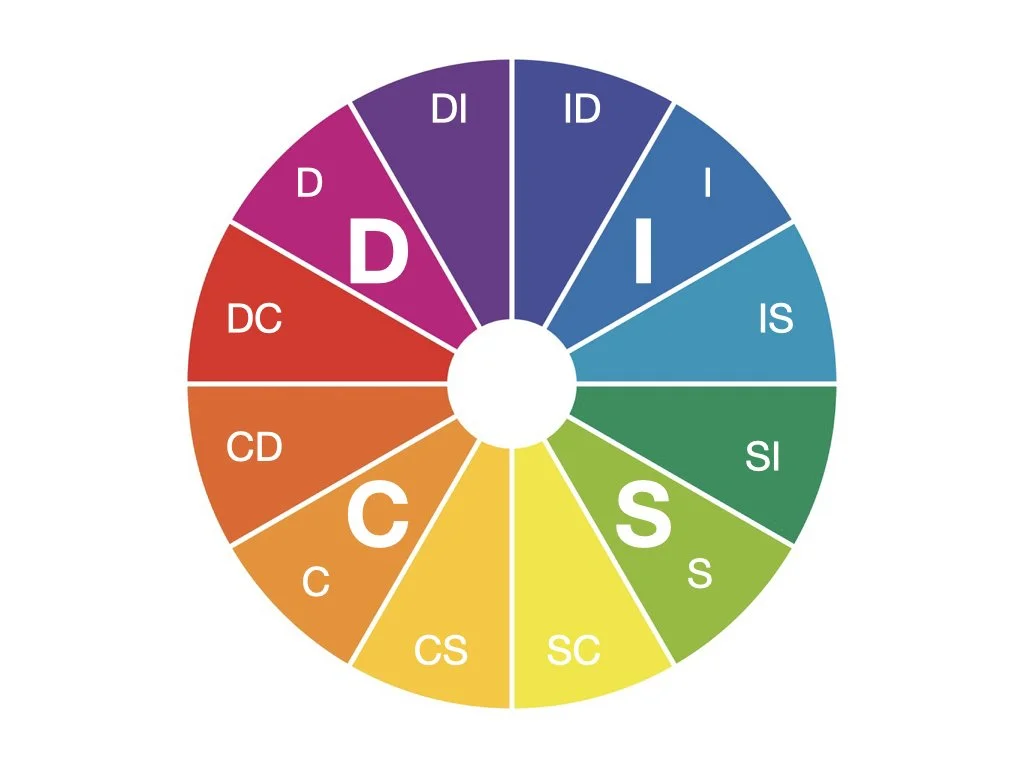
The DISC model identifies 12 distinct styles. While the four primary dimensions are Dominance, Influence, Steadiness, and Conscientiousness, most people display a blend of two adjacent dimensions. Everything DiSC maps these blends into 12 styles — such as D, DC, DI, i, iD, iS, S, Si, SC, C, CS, and CD — each with its own characteristic priorities and tendencies. No style is better or worse than another; they simply represent different natural approaches to work.
What is the difference between DISC and a personality test?
DISC is a behavioural assessment, not a personality test. Personality tests measure deep, stable psychological traits that are largely fixed over time. DISC focuses specifically on observable workplace behaviour — how people communicate, make decisions, and collaborate — which can be understood and adapted. This distinction makes DISC more immediately practical: rather than describing who someone fundamentally is, it describes how they tend to act at work and how they can adjust their approach to work more effectively with others.
DISC and Team Development Insights + Articles




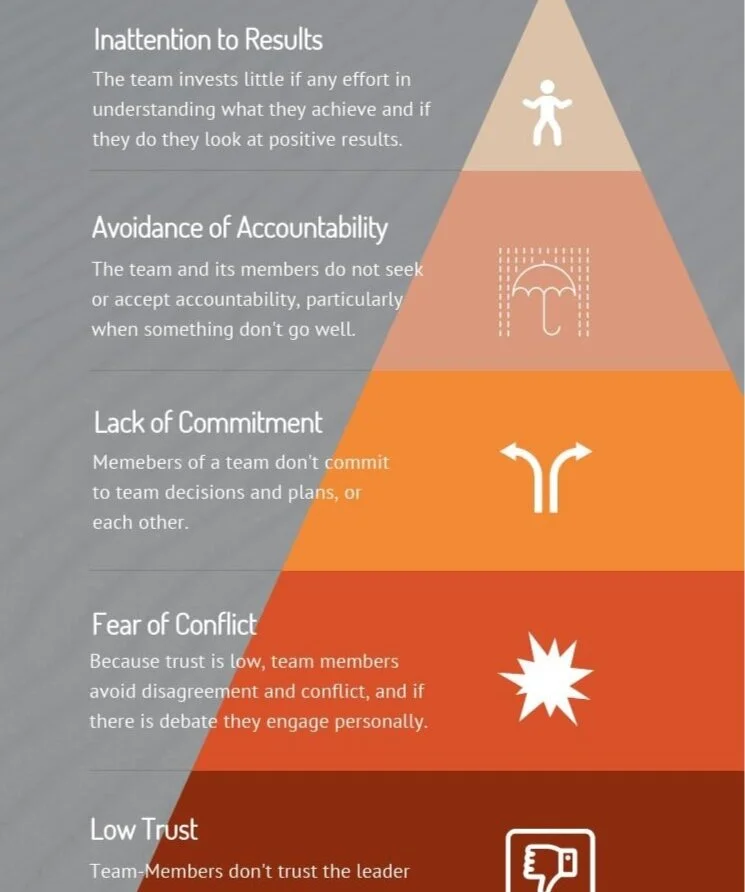
Four proven, real world behaviours that will lift your team’s functionality and performance.